
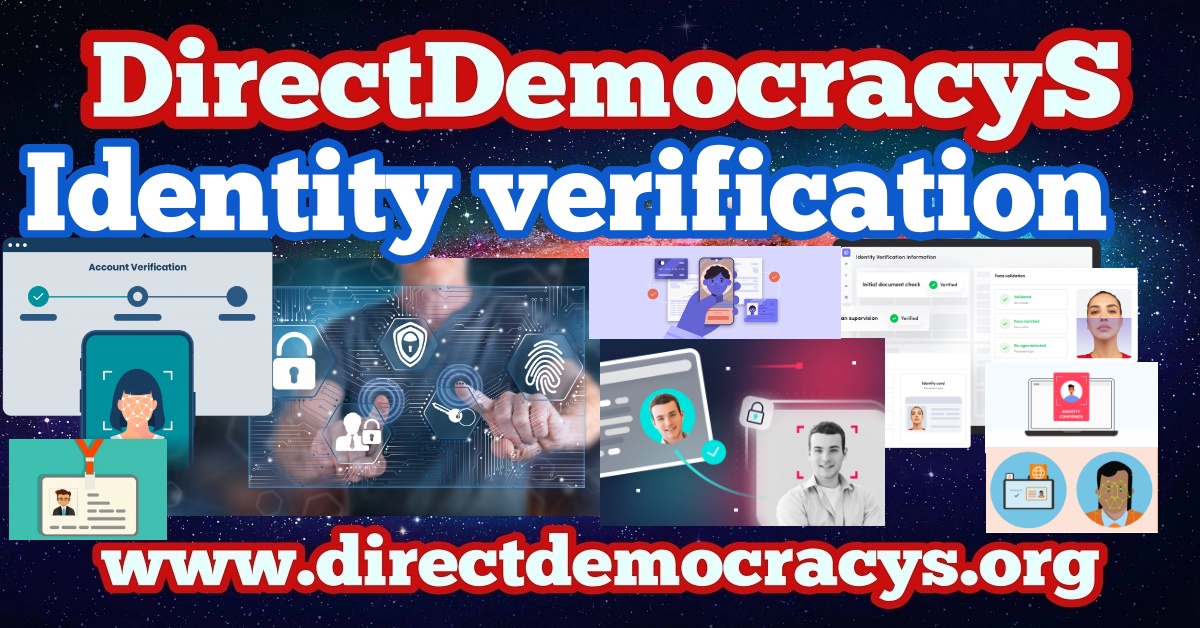
Verifying the identity of higher-level users is essential for them to be part of our truly shared leadership, and, or, our collective ownership.
Shared leadership allows all our registered users, with verified and guaranteed identities, to legally vote on all our decisions, in a manner binding on our system. This allows them to be a key player in all our decisions, making informed and competent choices based on comprehensive information received from our teams of specialists.
Collective ownership allows all our official members to own our entire system, receiving a single, non-cumulative, and non-transferable individual share.
If registered users with verified and guaranteed identities can vote and carry out activities in areas reserved for their user type, our official members will not only have the right to a binding vote for our system, but thanks to collective ownership rights, they will have a wealth of potential, with information, and concrete management and verification activities, in areas reserved for this user type.
How do we verify the identity of those who want to join us, or those who have joined us, in a lower user category, which does not require mandatory identity verification?
Simply request identity verification on our public website by entering three pieces of information in three fields: a unique username (not used by anyone else); a unique personal email address (not already used in our system by another registered user); a secure, non-temporary email address (you will receive instructions, unique verification codes, and other information); and a unique phone number (not previously registered in our system).
Here are some helpful explanations.
You must choose a username according to our username selection rules, which you can find at this link:
The username must be unique (not previously registered by our system) and must not create any potential problems (usernames that could mislead our users or visitors are not permitted, such as: administrator, manager, guarantor, coordinates or geographical names, which are permitted, but are reserved for our official representatives).
The email address must be entered correctly and completely in the appropriate field, so always check before submitting the initial form. If you write it incorrectly, you will lose the ability to proceed to the subsequent steps.
The telephone number must be written in full, exactly as it is used for someone calling you from abroad (you can request information online to find out how to write your telephone number). It must therefore contain correctly and completely : your country code (country code), the operator code (operator prefix), and the telephone number.
Phases in chronological order.
Step 1. Request identity verification.
As we've seen, you can be a registered user of the user type, without identity verification, or you can be a person who hasn't yet registered in the system. If you're already registered, you'll need to use the form visible only after logging in to our website. This automatically fills in your username and email address, which you've already chosen and confirmed in the registration form. You'll then simply need to enter your phone number following the previous rules.
The previous phases are called phase 0.
Phase 01. Compatibility with our system.
Step 1.1. Our system will send you an email with your unique identity verification code.
Step 1.2. Our system will send an email with your unique identity verification code (different and invisibly linked without special permissions for specific cases) to a randomly selected member of one of the many identity verification groups, also specializing in compatibility checks. They will contact you by email to verify your compatibility with our system.
Step 1.3. Our member will send you a link to one of our compatibility tests via email or internal message on our website. We have so many, it's impossible for anyone to know which one you'll receive. If you pass the test, you'll have a video call to verify your compatibility with DirectDemocracyS.
Phase 01.4. Our member, with a simple majority vote from their group, will enter a unique code received to begin Phase 01 (in Phase 01.2), and will give the final result of this phase: they will approve, reject, or postpone their decision (assigning you to another group and another member of the other group), they will assign you a score from 0 to 10, and you will be able to move on to the next phase, or you will have to start over from Phase 01. In any case, you will receive the result via email, or via an internal message in our system. Please note: those who are already registered will neither be blocked nor expelled, but will remain as their previous user type, due to incompatibility with higher user types.
Phase 01.5 Based on the result you receive, you can decide to continue, postpone, give up, or start again from phase 01.
Phase 02. The skills.
Phase 0 2.1. Our system will have already sent you an email with your unique identity verification code for Phase 2, based on the results of Phase 01 and your decisions.
Step 2.2. Our system will send an email with your unique identity verification code (different and invisibly linked without special permissions for specific cases) to a randomly selected member of one of the many identity verification teams, also specializing in skills verification, based on your statements, documents, and attached evidence. The team will contact you by email, along with our team of experts, to verify your qualifications for our system.
A brief explanation to avoid misunderstandings. DirectDemocracyS is not a system that accepts only people with degrees from renowned universities, or those with excellent educational or professional achievements. Anyone can be competent in certain activities, but if someone claims to be an expert in a particular field, they must demonstrate this, otherwise they can always join us, carrying out activities suited to their skills. We are a professional system, not an amateur one, and only by putting the right people in the right places can we achieve excellent results, for the common good.
Phase 2.3. Based on very detailed, specific instructions, your skills will be verified and evaluated. After completing all the various phases, you will receive a message similar to the one received in Phase 1, and you will be asked to make similar decisions. You will also receive a unique skills verification code, which will allow you to request access to one of our specialist groups. We repeat: each person has specific qualities, and to be useful to others, to themselves, and to our system, they must do what they do best. Of course, there are free internal groups, in areas reserved for those interested in certain topics, and with non-specialists, where you can carry out certain activities. However, these cannot constitute a constraint on our system, which bases official activities on various topics, and informational ones, with true experts and certainly not with incompetent individuals.
Phase 3. Identity verification. This process takes place only after assessing compatibility with our system (phase 1) and the skills declared, documented, demonstrated, and verified (phase 2). Each preceding phase will issue a unique code upon completion of its respective phase. This code will be received by the person requesting the activity (there may be different activities with different rules, but in this specific case, we're talking about identity verification) and by a randomly selected member from a group selected randomly among those specialized in the respective phases. The applicant must always keep the various codes received via email with them, or if they are already our users, they will receive an internal message in our system, which they will see as soon as they log in to our website. For security reasons, both the person requesting the activity and the member they contact must prove they are authorized to complete the various phases. The randomly selected member will first have to greet you, and then be able to tell you the unique code of the requested activity, which the applicant will have received via email or, if they are already our users, which they will have received via an internal message visible after logging in , which our system automatically generates, for each activity, after requesting the activity itself, using a simple form, on our website.
Step 3.1. Our system will have already sent you an email with your unique identity verification code for Step 3, based on the results of Step 1 and Step 2, and your decisions.
Step 3.2. Our system will send an email with your unique identity verification code (different and invisibly linked without special permissions for specific cases) to a randomly selected member of one of the many identity verification groups. This member, along with our security groups, will contact you via email to verify your identity for inclusion in our system, either with a verified and guaranteed identity, or as an official member.
Step 3.3. Identity verification video call.
The identity verification video call takes place after Phases 1 (compatibility check) and 2 (skills check) of these rules. After completing the first two phases, the user will receive a unique code certifying their compatibility and skills via email. If the person requesting the identity verification video call is one of our users who is already registered and activated, the message with all the instructions and all the unique codes will be sent via an internal message to their personal profile in the social area of our website or on our platforms. This unique code must be written down and sent by the person requesting the identity verification to a member of the identity verification group, usually before starting the identity verification, in the internal chat of the video call. This unique code is selected randomly from among all the groups authorized to perform certain activities. A brief explanation. In all other previous phases 1 and 2, which verify the compatibility of skills, we are not interested in your first and last name or personal information, but only your username (chosen by anyone according to our rules) and your personal email address. The reason is simple: it is our users who must be compatible with our system and also demonstrate their skills. In DirectDemocracyS, they are identified solely and exclusively by their username. Therefore, anyone who chooses an anonymous username, unrelated to their real first and last name, can carry out all activities with all the necessary safeguards to guarantee everyone's anonymity. When uploading an identity document or a partial identification file, which is a selfie of your face, with a clearly visible neighbor, and your photo ID (passport or ID card), the document or file is encrypted, analyzed, and verified with the collaboration of various national authorities, first by our system and then by our Artificial Intelligence model, without any human intervention. It will be stored on various servers within our platforms, inaccessible from the outside and accessible internally only in very serious cases by a very few super administrators, based on authorizations with real, documented, and justified reasons. In the third phase, with the identity verification video call, the member selected at random from among all the members of each group, from one of the groups authorized to perform this type of activity and identity verification, will not know the username of the person whose identity they are verifying. They will only know that the person whose identity they are verifying will have to provide a unique code received in the previous phase, which they themselves know, and that they will have to perform a few simple checks, such as raising a hand or turning their head in one direction (to verify that they are actually live). They will then have to have the person hold up their valid photo ID (passport, ID card, or in some cases other photo ID) close to their face. Then, they will have to hold the ID alone up to the camera and confirm, deny, or refer the user to another user following the same rules as before the identity verification, only in case of doubt. After one of the situations in the previous sentence, you will receive an email with a unique code (or, for existing users, an internal message on their personal profile) to confirm your identity. You will also receive a unique code to try to have another member verify your identity if the first member is unsure and does not assume responsibility for verifying that the person in the video is the person on the ID. You will also receive a code to try again one time if the first member certifies that the person in the video is not the person on the ID. In the latter case, you will have another attempt, but our system, our AI model, and a third member selected at random from another randomly selected group will analyze both videos (because each video call is recorded, encrypted, and stored on a server inaccessible from the outside). If the person is deemed to be the one on the ID document, even after checking with the various authorities and comparing the data, a unique code will finally be sent (to the email address or personal profile) that guarantees identity verification. At each check, the username will appear to be verified and guaranteed, as no one can connect the real data to the identity verification (real name and surname and other personal data) of the previous steps. If after several checks there are any doubts, the person in the video, and the person on the ID document, will be declared persona non grata in our system and will never be able to join us again. The video call lasts only a few minutes, but it is very important because it allows those in compliance to truly and completely participate in our shared leadership, or to become collective owners of our entire system, becoming our official member.
In-person identity verification.
For all our official members wishing to obtain an official representative profile, or alternatively a political representative profile, in addition to the previous steps, there is in-person identity verification by our special security team, with rules similar to those of the video call, but done live, in person.
Step 03.4. Verification of personal identity.
For all our political representatives (who perform internal, external, or both political representation) and for all our official representatives (who manage all our activities but do not participate in closed online primaries), at any time after identity verification via video call, there is an additional identity verification process: direct in-person verification. An official representative, selected at random from one of our randomly selected groups authorized for this activity, will contact the representative via our internal chat to meet in person and verify, in this exact order: their respective authorizations, and their respective identities (in this case, the identities are mutually verified for obvious security reasons, always and only after verifying their respective unique codes). In this case, too, the applicant/new representative and the person verifying the identity will have unique codes for each step, making the entire process quick, simple, confidential, anonymous, encrypted, and secure. How is anonymity guaranteed if one of our authorized members verifies someone's identity? Simply through mutual verification. Both the applicant/new representative and our representative will know each other's identities, and this is the only case of mutual verification. The only person who could, in theory, disclose their identity after verifying the identity of the verified representative in person, having been verified themselves (either before requesting the activity or by the applicant). Should they disclose any identity information (except for the unique code and the data required to confirm the identity verification, assuming full responsibility for the activity), they could be severely punished and even reported by our system and by the verified person. It should be noted, however, that all our political representatives and all our official representatives, after becoming our official members, will, according to implementing rules, receive a representative profile that cannot be linked to their personal profile, which is partially or completely public. In the case of our political representatives, the username for their political representative profile must be their full name and surname, written in their national language, using the characters specific to their language. Why don't we guarantee anonymity to our political representatives? Because in order to participate in the selection of our political representatives, which is mandatory, to participate in our internal political activities, and if one meets all the requirements, to run for office in our closed online primary elections, according to very detailed specific implementing rules, one must first request—and, if one meets all the requirements, obtain—a partially public political representative profile. This profile uses the applicant's full name and surname as the username, as specified above. Even all our official representatives, while they may have completely anonymous usernames, even area names or geographic coordinates, must always identify themselves locally, in person, at the various concrete activities in their area, or online on our platforms, to apply our fundamental rule: all our representatives must be identifiable by the people with whom they conduct all their activities. For all other types of users, complete and continuous anonymity is guaranteed, and it's impossible to link real personal data to their username, which virtually guarantees complete invisibility both to internal and, especially, external users. Everyone sees only one username, which cannot be linked to their real personal data. In DirectDemocracyS, everyone always uses their username, for any activity.
But how do we identify all the types that are guaranteed anonymity, if the randomly selected member, to make the video call, sees the images and the ID, of the identity verification activity required?
This is because everything unfolds in multiple phases, involving many groups and members, selected at random. They cannot be linked together without special authorization, obtained by a few of our super administrators for very serious reasons. Almost all phases are completely anonymous; our members receive a username (which can be anonymous) and unique codes that cannot be linked together. Those randomly assigned the task for the video call phase are unaware of previous activities; they only receive the various confirmations via email and unique codes. They are the only ones to receive their real name and surname, not their username, which must never be revealed by the applicant. The member participating in the video call simply checks that the person's face in the video is identical, or very similar, to the face on their photo ID, which the person in the video will display next to their own face and then to the camera when requested during the video call. After this verification, our system will automatically issue two different unique codes. One will be issued by the member who verified the identity, who will confirm the identity, assigning a score from 6 to 10 based on how confident they are that the person in the video is actually the person on the ID. In some cases, they will not confirm the identity of the verified person, even assigning a score of 0. Or, if they are unsure, they will assign another member, randomly selected by our system, the task of verifying the identity via another video call. New unique codes will be issued, assigning a score from 1 to 5 based on the likelihood that the person is actually the person on the photo. At this point, some people will rightfully wonder: what about countries where the photo is not visible on the ID card, or is nonexistent? There are two options. The first is to use a passport (which usually has a photo in every country in the world) or another official photo ID during the video call, along with the ID card. The second is to officially authorize, with a valid document notarized or digitally signed, sent to us in good time before requesting identity verification. This is done via a simple form, before the video call. Our DirectDemocracyS system will officially receive an official photograph of the person holding the document from the authorities of the country where the ID is issued. This photograph will be automatically sent by our system only to the official member making the video call, who will verify that the person showing the ID is identical, or very similar, to the photograph we received from the respective authorities.
Are video calls recorded?
All our identity verification video calls are recorded, and the official group member verifying the identity is instructed to record the verification video call. The requester, in the instructions they receive before making the video call, is informed that the video call will be live, encrypted, recorded, and stored, after the identity verification is complete, on our platforms, on a web server that is not accessible from outside. After a period of time, usually a year, or after another identity verification, because our security team may wish to verify the identity of any of our users at any time—not so much to verify their identity, but to ensure that only the verified person is using the personal profile—the old video is replaced with the newer one. Alternatively, if, during the immediate verification process, it is discovered that another person is using the personal profile of one of our users, violating a fundamental rule, the profile of the person guilty of the violation, and automatically all profiles linked to their personal profile, will be immediately blocked, and the appropriate measures will be initiated to punish those who do not comply with our rules.
Brief explanation: Instant identity verification requires a unique authorization code, which will be presented by the person verifying their identity, and the code will be sent to the user via internal message or email. If the user logs out before the verification is finalized via an immediate video call, and then logs back in, it will be considered an admission of guilt and a declaration that they allowed someone else to use their personal profile. They will therefore be immediately blocked and declared guilty, with no right of appeal. However, if, after verifying the unique code, they make the video call and everything is in order, everything will remain as before, and they will be able to continue their activities. If the person verifying their identity is someone else during the verification, their personal profile will be immediately blocked. If there are any doubts even after recording the video call, the personal profile will be blocked until all activity has been verified and the identity is verified again. This will be done by comparing the two videos (the initial and the second) in the first phase. After the third video call, the three videos (the initial, the immediate, and the subsequent) will be compared. If the identity is confirmed, the verified person will remain part of our system. Otherwise, they will remain blocked and permanently banned.
Continuous and unexpected checks ensure compliance with all regulations and the legality of all our activities. Only members of the security groups whose usernames include "Security" can verify at any time, using an authorization code, the identity of all our users, regardless of their higher user type, who have a blue check mark next to their username. Therefore, thanks to the blue check mark, they are registered users with a verified and guaranteed identity. Anyone who does not have a blue check mark next to their username in our social media area, on our websites, and on our platforms, is not entitled to a binding vote for our system because they are not part of our truly and fully shared leadership.

















































































a. To accept full responsibility for the comment that you submit.
b. To use this function only for lawful purposes.
c. Not to post defamatory, abusive, offensive, racist, sexist, threatening, vulgar, obscene, hateful or otherwise inappropriate comments, or to post comments which will constitute a criminal offense or give rise to civil liability.
d. Not to post or make available any material which is protected by copyright, trade mark or other proprietary right without the express permission of the owner of the copyright, trade mark or any other proprietary right.
e. To evaluate for yourself the accuracy of any opinion, advice or other content.